
The University of Cambridge's Mathematics Faculty has launched a new, pilot project providing free online support and preparation resources for students now in Year 12 who may want to take STEP (or the Oxford MAT) in Year 13. STEP (Sixth Term Examination Paper) is an additional examination which usually forms part of conditional offers to mathematics applicants at Cambridge and some other universities.
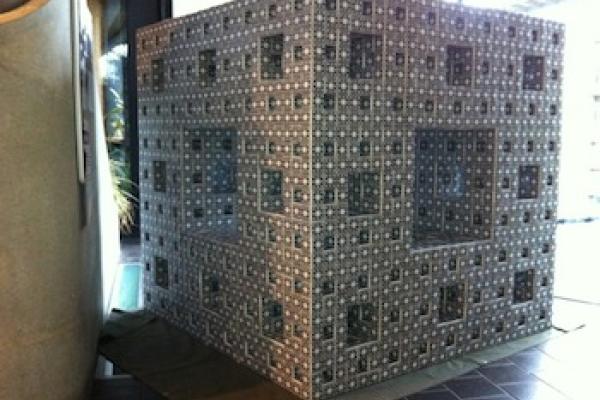
Thank you to all the school students, Cambridge students and staff and members of the public who helped to build part of the world's largest ever distributed model fractal out of business cards! The model represents a Menger sponge: a (nearly) three-dimensional fractal cube, which has so many holes it contains no volume at all, but is so crinkly it has infinite surface area. The Level 3 model cube, which is proudly on view in the Centre for Mathematical Sciences, is built out of 8,000 smaller cubes, each made from 6 folded business cards.


Join us at the Centre for Mathematical Sciences on Saturday 25 October for a day packed with hands-on mathematical activities, including the chance to take part in the global MegaMenger event - an attempt to build the world's largest ever distributed model fractal out of business cards! A Menger sponge is a (nearly) three-dimensional fractal cube, which has so many holes it contains no volume at all, but is so crinkly it has infinite surface area..
You can now watch videos of the two plenary talks from our Year 12 Mathematics Enrichment Day online. 120 Year 12 students (aged 16-17) from 13 different schools took part in the full-day event on 27 June 2014, which had a special focus on encouraging the development of mathematical thinking. The enrichment day programme included two plenary talks, by Professor Imre Leader and Professor David Tong. In addition, each student took part in two different small-group mathematical workshops over the course of the day.
Conducting scientific research is an experience that is rarely accessible outside universities. During a new project in the 2014/15 school year, however, a group of researchers from the Centre for Mathematical Modelling of Infectious Diseases aims to give secondary school pupils (Y9 or Y10) the opportunity to work on a real scientific research project. The research team is now inviting applications from schools to participate as a research partner school in the project.
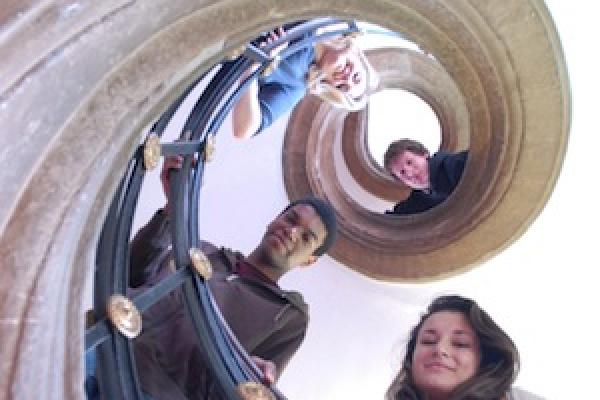
Staff from NRICH and the Cambridge Mathematics Education Project are working with the Faculty of Mathematics, Cambridge Admissions Office and Cambridge colleges to run the Cambridge STEP Easter School in April 2014.

Around 1,200 children and members of the public participated in the maths events we organised as part of the Cambridge Science Festival in March 2014. The annual Cambridge Science Festival takes place over two weeks in March each year, and is one of the largest public understanding of science festivals in the UK. In 2014 the Festival included more than 250 events in total, attended by an estimated 35,000 people.
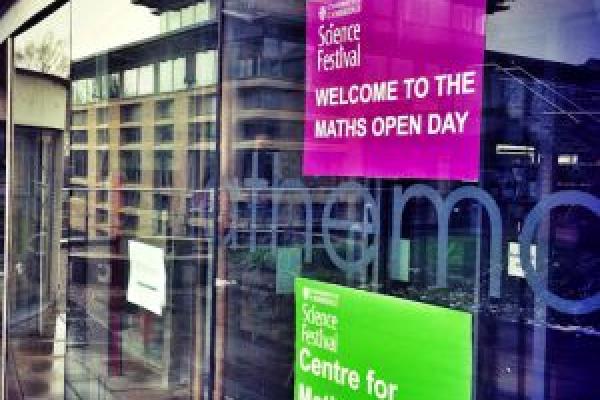
Don't miss our free events for the Cambridge Science Festival on Saturday 22 March 2014! Join MMP staff and volunteer Cambridge student helpers at the Centre for Mathematical Sciences for a Hands-On Maths Fair between 11.30am and 4pm. Famously, G.H. Hardy described mathematicians, like poets and painters, as makers of patterns, and mathematics as a creative art.

The 20th annual University of Cambridge Science Festival takes place from 10-21 March 2014, with more than 250 events for all ages. You can browse the full programme on the Cambridge Science Festival web pages, but we've also picked out some of the Festival's mathematical highlights for you below. From animal patterns to string theory, prime numbers to the Simpsons, the free public talks on offer cover a huge range of mathematical topics.
